Introduction
3-bucket money system Managing money doesn’t have to be complicated. The 3-Bucket Money System gives you a simple way to organize your income, control everyday spending, prepare for unexpected expenses, and invest for the future. Whether you’re just starting your financial journey or looking for a better budgeting strategy in 2026, this approach can help you give every dollar a clear purpose and build stronger financial habits over time.
3-bucket money system Managing money is not always about earning more. Sometimes, the bigger challenge is knowing what to do with the money you already earn.
Managing money doesn’t have to be complicated. The 3-Bucket Money System is a simple and practical approach that helps you organize your income into three clear areas: spending, safety, and growth. Instead of wondering where your money goes every month, this method gives every dollar a purpose—from covering everyday expenses and building an emergency fund to investing for your future.
3-bucket money system Many people receive their salary or business income, pay a few bills, spend 3-bucket money system on everyday needs, and then discover at the end of the month that very little is left. Even people with a good income can struggle to save because their money does not have a clear purpose.
This is where a simple 3-bucket money system can help.
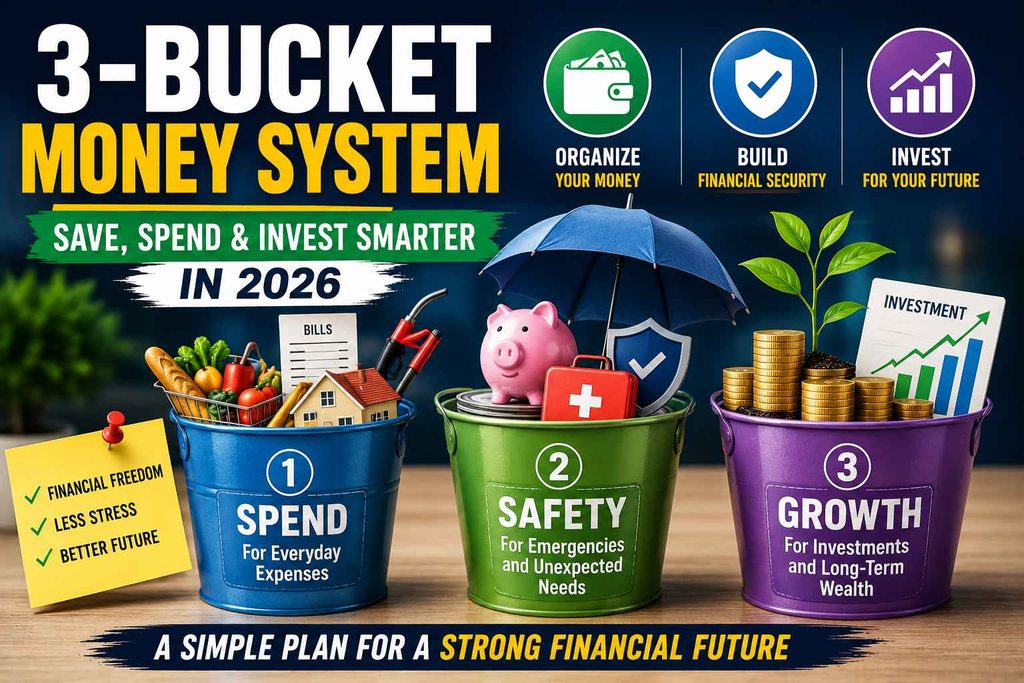
Instead of treating all your 3-bucket money system as one large amount, you divide it into three different financial buckets:
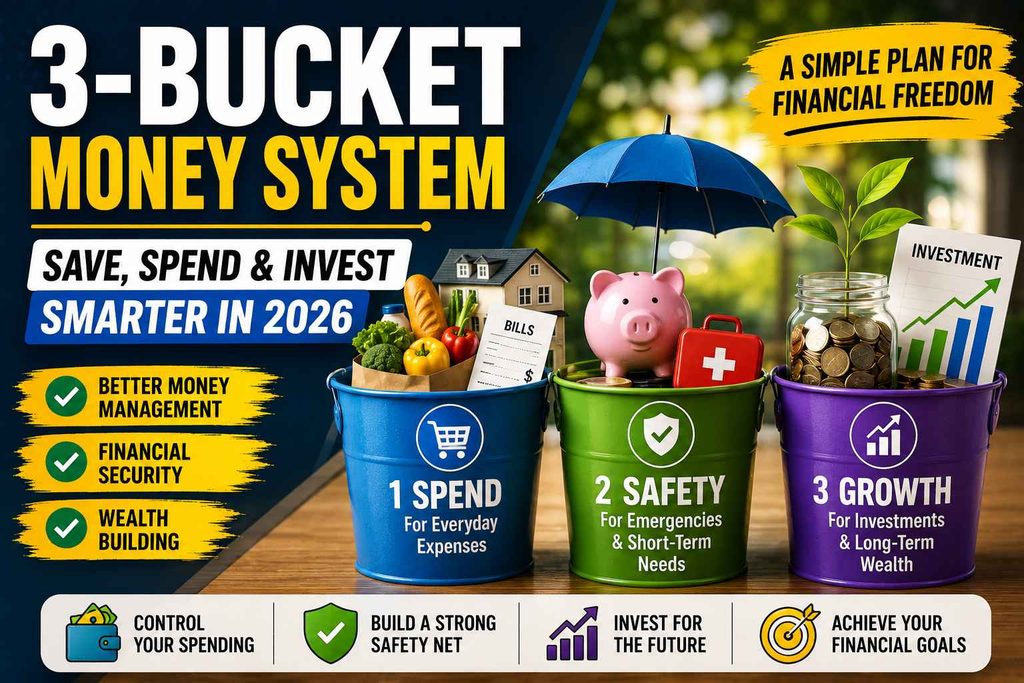
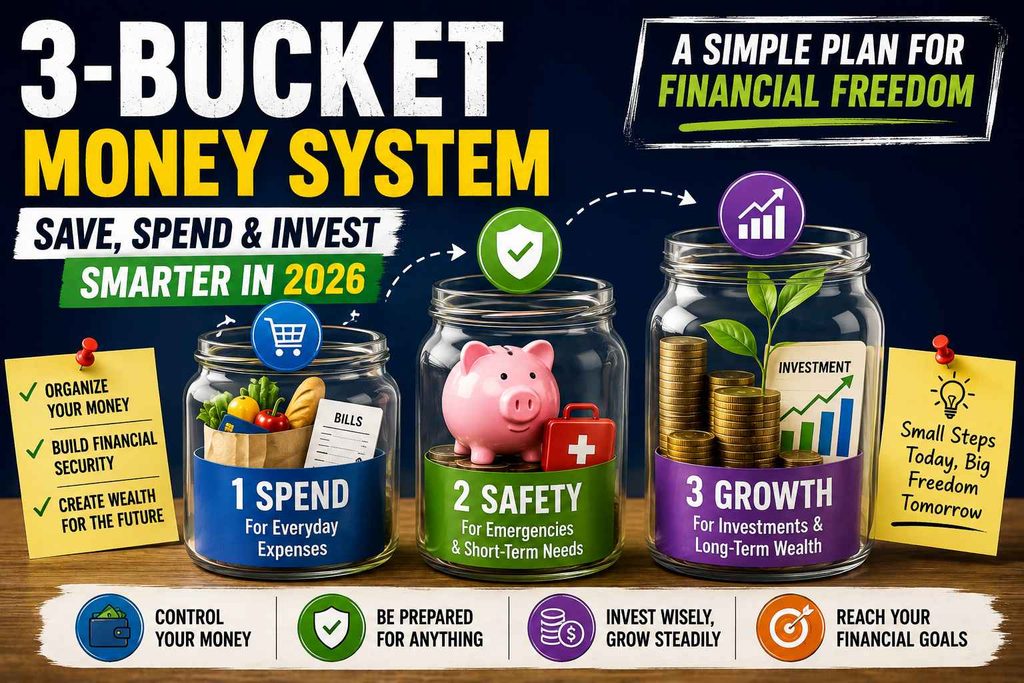
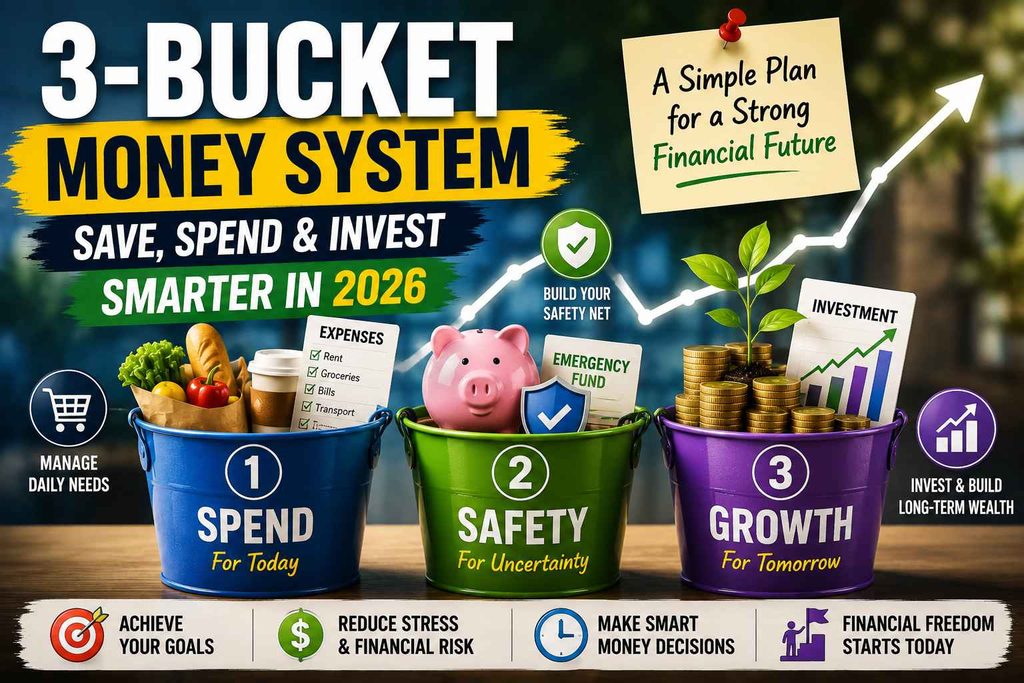
- Spend Bucket – money for everyday expenses and bills
- Safety Bucket – emergency savings and short-term financial needs
- Growth Bucket – money for long-term investing and wealth building
The idea is simple: every dollar or rupee you receive should have a job.
3-bucket money system This approach can make budgeting easier, reduce unnecessary spending, improve financial security, and help you invest consistently.
In this guide, we will explain how the 3-bucket money system works, how to set it up, its pros and cons, common mistakes to avoid, and how you can adapt it to your own income.
https://myfinancenests.com/?utm_source=chatgpt.com
What Is the 3-Bucket Money System?
The 3-bucket money system is a budgeting framework that separates your income according to its purpose.
Think of your 3-bucket money system as being placed into three different containers.
Bucket 1: Spend
This bucket handles your regular lifestyle.
It can include:
- Rent or mortgage
- Food
- Utility bills
- Transportation
- Internet and phone bills
- School or education expenses
- Household purchases
- Entertainment
- Other regular expenses
The purpose is to make sure your everyday financial obligations are covered.
Bucket 2: Safety
The second bucket is designed to protect you from unexpected financial problems.
This can include:
- Emergency savings
- Medical expenses
- Car repairs
- Unexpected household costs
- Temporary loss of income
- Urgent travel
- Other short-term financial emergencies
The 3-bucket money system should generally be kept somewhere accessible rather than exposed to unnecessary investment risk.
Bucket 3: Growth
The final bucket is for your future.
This is where long-term wealth-building money can go.
Depending on your goals and circumstances, this could include:
- Retirement investments
- Diversified funds
- Long-term stock-market investments
- ETFs
- Business investments
- Education funds
- Other long-term assets
The important principle is that this money is intended for long-term growth, not everyday spending.
Why Does the 3-Bucket System Work?
One reason people struggle with money is that their entire income sits in one account.
When everything is mixed together, it becomes difficult to answer simple questions:
How much can I spend?
How much should I save?
Can I afford this purchase?
Am I investing enough?
A 3-bucket money system system gives every part of your income a specific purpose.
For example,3-bucket money system imagine someone earns $3,000 per month.
Instead of viewing the entire $3,000 as available money, they could create a plan such as:
- $1,950 for spending
- $600 for safety savings
- $450 for long-term growth
The exact percentages should not be treated as universal rules. Your numbers should depend on your income, debt, family responsibilities, location, financial goals, and existing savings.
The key idea is separation, not a specific percentage.
Bucket 1: Build a Strong Spending System
The first bucket is your spending bucket.
This is probably the easiest one to understand because it covers the things you need to pay for every month.
However, there is an important distinction between needs and wants.
Needs
These are expenses that are generally necessary.
Examples include:
- Housing
- Basic groceries
- Utilities
- Transportation
- Insurance
- Essential healthcare
- Minimum debt payments
Wants
These are 3-bucket money system expenses that can improve your lifestyle but are not always necessary.
Examples include:
- Restaurant meals
- Streaming subscriptions
- Expensive gadgets
- Entertainment
- Luxury purchases
- Frequent shopping
- Unplanned online purchases
The goal is not to eliminate every want.
The goal is to make sure wants do not consume money that should be going toward your safety and future.
https://www.investor.gov/introduction-investing/getting-started/asset-allocation?utm_source=chatgpt.com
Create a Monthly Spending Limit
One of the simplest improvements you can make is creating a spending limit before the month begins.
For example:
Monthly income: $3,000
You might decide that your spending bucket cannot exceed $2,000.
Once that limit is established, you know that the remaining money has other purposes.
This is much easier than spending first and trying to save whatever happens to remain.
A useful rule is:
Save and invest first, then spend what is available.
This concept is often called paying yourself first.
Bucket 2: Build Your Financial Safety Net
The second 3-bucket money system is your financial safety net.
This is especially important because unexpected expenses can destroy a budget.
Imagine that you have no emergency savings and suddenly:
- Your car needs an expensive repair.
- Your income temporarily decreases.
- You have an unexpected medical bill.
- Your home needs urgent repairs.
Without savings 3-bucket money system, you may need to use a credit card or take a loan.
That can turn a temporary problem into a long-term financial burden.
An emergency fund can provide a financial cushion.
How Much Should You Keep in Your Safety Bucket?
There is no 3-bucket money system single number that works for everyone.
A common starting goal is to build enough savings to cover several months of essential expenses.
For example, if your essential monthly expenses are $2,000, then:
3 months = $6,000
6 months = $12,000
Someone with stable employment and low financial obligations may choose a smaller reserve, while someone with irregular income or significant responsibilities may want a larger cushion.
The important thing is to start.
You do not need to build the entire emergency fund in one month.
Even putting aside a small amount consistently can move you toward your target.
Where Should Emergency Money Be Kept?
Emergency savings should generally be:
- Easily accessible
- Low risk
- Separate from everyday spending
- Available when you actually need it
The emergency fund is not primarily designed to maximize returns.
Its main purpose is financial protection.
This is an important distinction.
Your investment account is designed for growth.
Your emergency fund is designed for stability.
Trying to maximize the return on emergency money can sometimes introduce risks that defeat the purpose of having an emergency reserve.
Bucket 3: Turn Your Money Into Long-Term Growth
The third 3-bucket money system is where your money starts working toward your future goals.
Investing can help you build wealth over a long period, but it is important to understand that investments can lose value.
The stock market does not move upward every day.
There can be:
- Market corrections
- Bear markets
- Economic downturns
- Business failures
- Interest-rate changes
- Geopolitical uncertainty
Therefore,3-bucket money system money that you may need next month generally should not be treated the same as money you can leave invested for many years.
Why Long-Term Investing Matters
One of the biggest advantages of investing consistently is the potential benefit of compounding.
Compounding occurs when your investment returns generate additional returns over time.
For example, suppose someone invests $300 every month.
The amount they contribute is important, but the length of time the money remains invested can also make a significant difference.
This is why starting early can be powerful.
However, returns are never guaranteed.
A sensible investment strategy should consider:
- Risk tolerance
- Investment horizon
- Diversification
- Fees
- Financial goals
- Ability to tolerate market declines
Never invest money simply because you feel pressured to make quick profits.
A Simple Example of the 3-Bucket System
Let’s imagine a person earns $4,000 per month.
Instead of giving every dollar the same purpose, they create three buckets.
Spending Bucket
$2,600
Used for:
- Housing
- Food
- Transportation
- Utilities
- Personal expenses
- Entertainment
Safety Bucket
$800
Used for:
- Emergency savings
- Short-term financial goals
- Unexpected expenses
Growth Bucket
$600
Used for:
- Long-term investments
- Retirement
- Wealth-building goals
These numbers are only an illustration.
Someone with high rent might need more for spending.
Someone with a large emergency fund might redirect more money toward investing.
Someone with expensive high-interest debt may need to prioritize debt repayment before increasing investments.
The system should adapt to your situation.
What If You Have Debt?
Debt changes the calculation.
Not all debt is equally expensive.
High-interest consumer debt can make it difficult to build wealth because interest costs can consume a large portion of your income.
If you have expensive debt, you may need to prioritize:
- Essential expenses
- A basic emergency reserve
- High-interest debt repayment
- Long-term investing
The exact order can vary depending on your circumstances.
For example, maintaining a small emergency reserve may still make sense while aggressively paying down expensive debt.
The important thing is not to build an impressive investment portfolio while simultaneously allowing high-interest debt to grow out of control.
3-Bucket System vs Traditional Budgeting
A traditional budget may contain dozens of categories.
For example:
- Groceries
- Gas
- Electricity
- Internet
- Clothing
- Entertainment
- Restaurants
- Travel
- Insurance
- Savings
- Investments
- Education
This can be useful, but some people find detailed budgeting difficult to maintain.
The 3-bucket system simplifies the structure.
Instead of constantly monitoring dozens of categories, you focus on three major purposes:
Spend.
Protect.
Grow.
You can still use detailed categories inside the spending bucket if you need them.
Pros of the 3-Bucket Money System
1. It Is Simple
One of the biggest advantages is simplicity.
You do not need a complicated spreadsheet to understand where your money should go.
The three categories provide a clear framework.
2. It Encourages Saving
When savings are separated from spending money, you are less likely to accidentally spend them.
3. It Creates Financial Security
The safety bucket provides protection against unexpected expenses.
4. It Encourages Consistent Investing
Even a relatively small growth bucket can help establish an investing habit.
5. It Reduces Financial Confusion
Instead of asking where all your money went, you can clearly see how much is allocated to spending, safety, and growth.
6. It Can Be Automated
You can automate transfers after receiving your income.
For example:
Income arrives → spending account receives its amount → savings transfer happens → investment contribution happens.
Automation reduces the need for constant discipline.
Cons of the 3-Bucket Money System
Although the system is useful, it is not perfect.
1. It Can Be Too Simple
Some people need a detailed budget.
If you have many financial obligations, three buckets alone may not provide enough detail.
2. The Wrong Percentages Can Cause Problems
If you allocate too much money toward investments and not enough toward essential expenses, you may create unnecessary financial pressure.
3. It Requires Discipline
Creating buckets is easy.
Following them consistently is harder.
4. Investments Carry Risk
The growth bucket can lose value.
Therefore, you should not put emergency money into risky investments simply because you want higher returns.
5. Your System Must Change Over Time
Your financial situation can change.
A new job, marriage, children, business, home purchase, debt, or major life event can require a different allocation.
Common Mistakes to Avoid
Mistake 1: Treating the Emergency Fund Like Spending Money
Your emergency fund should not become your shopping account.
Mistake 2: Investing Before Understanding Risk
Do not invest simply because someone online promises fast returns.
Mistake 3: Ignoring High-Interest Debt
High-interest debt can work against your wealth-building efforts.
Mistake 4: Setting Unrealistic Saving Targets
A budget that is impossible to maintain will eventually fail.
Mistake 5: Changing Investments Every Week
Long-term investing requires patience.
Constantly reacting to market movements can lead to emotional decisions.
Mistake 6: Forgetting Irregular Expenses
Annual insurance payments, school costs, repairs, holidays, and other irregular expenses should be considered.
How to Set Up Your 3 Buckets Today
You can create the system in five steps.
Step 1: Calculate Your Monthly Income
Write down your average monthly income.
If your income changes every month, use a conservative estimate.
Step 2: Calculate Essential Expenses
List your necessary monthly costs.
This tells you how much your spending bucket needs.
Step 3: Set an Emergency Fund Target
Choose a realistic savings target based on your expenses and financial stability.
Step 4: Decide Your Investment Contribution
Choose an amount you can consistently invest without damaging your monthly budget.
Step 5: Automate Everything Possible
Automation can make the system much easier.
For example, on payday:
Income → Spending
Income → Safety
Income → Growth
This creates a financial routine instead of relying entirely on willpower.
How to Improve the System Over Time
The 3-bucket system should not remain exactly the same forever.
Review it every few months.
Ask yourself:
- Has my income changed?
- Have my expenses increased?
- Is my emergency fund large enough?
- Have I paid down expensive debt?
- Am I investing consistently?
- Are my financial goals still the same?
If your income increases, consider directing part of the additional money toward savings and investments instead of immediately increasing lifestyle expenses.
This can help prevent lifestyle inflation.
Final Thoughts
Building wealth does not always require a complicated financial strategy.
Sometimes the biggest improvement comes from giving your money a clear purpose.
The 3-bucket money system provides a straightforward way to organize your finances:
Bucket 1 — Spend: Handle today’s needs.
Bucket 2 — Safety: Protect yourself from unexpected financial problems.
Bucket 3 — Growth: Build toward tomorrow’s financial goals.
The exact amounts will depend on your personal circumstances. There is no universal percentage that everyone should follow.
The real strength of the system is its simplicity.
Instead of allowing your entire income to disappear into one account, you create a structure where your money is intentionally divided between lifestyle, protection, and future growth.
If you are just starting your financial journey, you do not need to make everything perfect immediately.
Start with a small emergency fund.
Control unnecessary spending.
Deal with expensive debt.
Then build a consistent long-term investing habit.
Over time, these small decisions can become a powerful financial system.
Smart money management is not about making one perfect decision. It is about making better decisions consistently.
Spend with purpose. Save for uncertainty. Invest for the future.
That is the real idea behind the 3-bucket money system.
Table of Contents