Introduction
Every successful Startup Idea Validation begins with an idea.
But here is the uncomfortable truth: not every good-looking Startup Idea Validation is a good business idea.
Many people spend weeks designing a logo, building a website, developing an app, registering a company, buying expensive software, and running advertisements before discovering that customers do not actually want what they are offering.
The problem is not always a lack of effort.
Sometimes, the problem is starting too big before proving that the idea works.
This is where startup idea validation becomes extremely important.
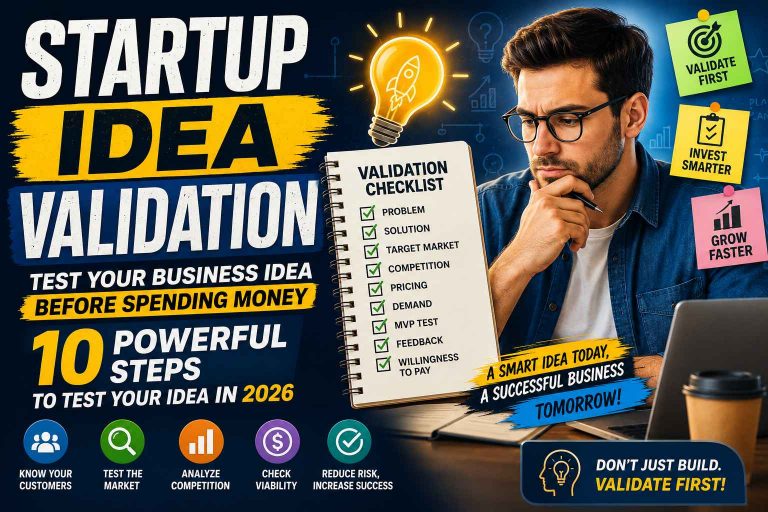
Startup idea validation is the process of testing a business idea before investing significant amounts of money, time, and resources into it. Instead of simply assuming that customers will buy, founders collect evidence from real people, real problems, and real market behavior.
In 2026, starting a digital business may be easier than ever. Entrepreneurs can build websites quickly, create prototypes with modern development tools, use AI to generate content and code, launch online stores, and reach potential customers through social media.
But easier technology does not automatically mean easier business success.
A founder can build an impressive product in a few days and still have zero customers.
That is why validation matters.
The goal is not to prove that your idea is perfect. The goal is to discover whether there is a real problem, a real audience, and a realistic opportunity to build a sustainable business.
In this guide, MyFinanceNests explains how to validate a startup idea before spending serious money, including practical steps, advantages and disadvantages, common mistakes, useful examples, FAQs, and final thoughts.
What Is Startup Idea Validation?
Startup idea validation means testing whether people actually have a problem that your proposed product or service can solve.
Think about it this way.
Suppose you have an idea for an application that helps freelancers manage their invoices.
You may personally think:
But that is only an assumption.
Startup Idea Validation asks more important questions:
- Do freelancers actually experience this problem?
- How frequently do they experience it?
- How are they solving it today?
- Are existing solutions available?
- What do those solutions cost?
- Would customers pay for something better?
- What features actually matter?
- Can the business acquire customers profitably?
These questions can save a founder from making an expensive mistake.
Why Startup Validation Matters
Startup Idea Validation requires resources.
Even a small online startup may require money for:
- Website development
- Software
- Branding
- Advertising
- Domain and hosting
- Customer support
- Employees
- Legal services
- Product development
- Payment processing
If the underlying idea is weak, these expenses can quickly become difficult to recover.
Validation helps founders reduce uncertainty before making large commitments.
It does not guarantee success.
Instead, it improves the quality of the information available before important decisions are made.
The Difference Between an Idea and an Opportunity
Startup Idea Validation is simply something you think could work.
An opportunity has evidence behind it.
For example:
Idea:
“I want to build an app that helps students organize their study schedules.”
Potential opportunity:
“I interviewed 50 students, discovered that many struggle with managing multiple deadlines, found that existing solutions are either too complicated or expensive, and 15 students said they would consider paying for a simpler solution.”
The second situation provides much stronger evidence.
Startup Idea Validation becomes more interesting when a founder can connect:
Problem + Audience + Demand + Solution + Business Model
https://www.sba.gov/?utm_source=chatgpt.com

Step 1: Identify the Problem Before Building the Product
One of the biggest Startup Idea Validation mistakes is becoming emotionally attached to a solution.
Founders often say:
“I want to build this app.”
A better question is:
“What problem does this app solve?”
Suppose you want to build a restaurant management application.
Instead of immediately designing screens, investigate restaurant owners.
Maybe you discover their biggest problem is not ordering management.
Perhaps it is inventory waste.
Or staff scheduling.
Or payment reconciliation.
Or delivery coordination.
Your original idea may change completely after talking to potential customers.
That is not failure.
That is successful validation.
Step 2: Define Your Target Customer
A product designed for everyone often becomes a product that strongly appeals to no one.
You need to identify a specific target audience.
For example:
Instead of:
“Our software is for businesses.”
Try:
“Our software helps small online stores with 1–10 employees manage customer support.”
This is much more specific.
Your target customer profile might include:
- Age range
- Profession
- Business size
- Location
- Income level
- Technology usage
- Common problems
- Buying behavior
The more clearly you understand your customer, the easier it becomes to test the idea.
Step 3: Talk to Real Potential Customers
This is one of the most valuable validation methods.
Talk to people who could realistically become customers.
Do not simply ask:
“Would you buy my product?”
People often say yes because they want to be polite.
Instead, ask about their existing behavior.
For example:
- How do you currently solve this problem?
- How often does this problem happen?
- What is the most frustrating part?
- Have you paid for a solution?
- Which tools are you currently using?
- What do you dislike about those tools?
- How much time or money does this problem cost you?
These questions produce more useful information.
Step 4: Look for Existing Competitors
Competition is not necessarily bad.
In fact, competitors can be evidence that a market exists.
Startup Idea Validation Suppose you discover ten companies already solving a problem.
That tells you something important:
People may already be willing to pay for a solution.
Your challenge becomes finding a reason customers would choose your product.
You could compete through:
- Lower cost
- Better user experience
- Faster service
- Better customer support
- Specialized features
- A specific target market
- Easier setup
- Better integrations
Startup Idea Validation Trying to eliminate competition completely is usually unrealistic.
Step 5: Study Customer Complaints
Startup Idea Validation One of the smartest ways to validate a startup idea is to study what customers dislike about existing products.
Look at:
- Product reviews
- Discussion forums
- App reviews
- Social media comments
- Customer feedback
- Community discussions
Pay attention to repeated complaints.
Startup Idea Validation If hundreds of people complain about the same problem, you may have discovered a potential opportunity.
For example:
Imagine users of an existing software product repeatedly complain that:
- It is difficult to use.
- Setup takes too long.
- Customer support is slow.
- Pricing is confusing.
Those complaints can become clues for a new product.
Step 6: Analyze Search Demand
Search behavior can provide another useful signal.
Startup Idea Validation People frequently search the internet when they have problems.
Examples include:
- “How to manage invoices”
- “Best inventory software for small business”
- “How to track freelance payments”
- “Affordable CRM for startups”
Search demand does not automatically prove that people will buy your product.
However, it can help you understand whether people actively look for solutions.
Startup Idea Validation You can also study related search terms to discover how customers describe their problems.
This can help with both product development and future SEO strategy.
Step 7: Create a Simple MVP
MVP stands for Minimum Viable Product.
Startup Idea Validation It means creating the simplest version of your solution that allows you to test the core idea.
Startup Idea Validation objective is not to build a perfect product.
The objective is to learn.
Startup Idea Validation Suppose your startup idea is an AI-powered customer support platform.
You do not necessarily need to build:
- 50 integrations
- Mobile apps
- Advanced analytics
- Complex dashboards
- Multiple pricing systems
Your first version might only need:
- Customer uploads FAQs.
- AI generates answers.
- Business connects a simple chat widget.
- Customers ask questions.
- Business owner reviews responses.
Startup Idea Validation If customers use it and find value, you can gradually expand the product.
Step 8: Build a Landing Page
Startup Idea Validation A landing page can be an inexpensive way to test interest.
It should clearly explain:
- What the product does
- Who it is for
- What problem it solves
- Why it is different
- How people can join or request access
Instead of immediately building the entire product, you can invite visitors to:
Join the waitlist
or
Request early access
Startup Idea Validation The number and quality of responses can provide useful information.
However, remember that email signups are not the same as paying customers.
Step 9: Test Willingness to Pay
This is one of the most important stages of Startup Idea Validation.
People may say:
“That is a great idea.”
But compliments do not pay the bills.
The stronger signal is:
“I am willing to pay for it.”
You can test this by offering:
- Pre-orders
- Paid pilots
- Early-bird pricing
- Deposits
- Paid consultations
- Trial subscriptions
You should always be transparent about what customers are receiving.
The objective is to determine whether the problem is valuable enough for people to spend money solving it.
Step 10: Calculate Basic Startup Economics
Even if customers love your product, the business still needs sustainable economics.
Consider:
Customer Acquisition Cost
How much does it cost to acquire one customer?
Customer Value
How much revenue can one customer potentially generate over time?
Gross Margin
How much remains after direct costs?
Monthly Expenses
What will you spend on:
- Software
- Employees
- Hosting
- Marketing
- Support
- Operations
A startup does not necessarily need perfect financial projections in the beginning.
But founders should understand the basic economics.
Pros of Validating a Startup Idea
Startup validation provides several important advantages.
1. Reduces Financial Risk
The biggest benefit is that you can test an Startup Idea Validation before spending large amounts of money.
A small experiment is usually less expensive than building a complete product that nobody wants.
2. Improves the Product
Customer conversations can reveal features and problems you never considered.
The final product can therefore become more useful.
3. Helps Understand Customers
Validation forces founders to listen.
This can create a much clearer understanding of customer needs.
4. Identifies Market Opportunities
Research may reveal a smaller but more profitable niche.
For example, instead of serving all businesses, you might discover that one specific industry has a particularly painful problem.
5. Improves Marketing
Customer interviews reveal the language people use to describe their problems.
That language can later improve:
- Website copy
- Advertising
- SEO
- Social media
- Sales presentations
6. Builds Confidence
Evidence is more valuable than assumptions.
When customers consistently show interest, founders can make decisions with greater confidence.
Cons of Startup Validation
Startup Idea Validation is useful, but it is not perfect.
1. It Takes Time
Customer interviews, research, testing, and experiments require effort.
Some founders want to start building immediately.
2. Customers Can Give Misleading Feedback
People may say they like an idea but never actually purchase it.
That is why behavioral evidence is often stronger than opinions.
3. Small Samples Can Be Misleading
Talking to five people does not necessarily represent an entire market.
You need to be careful about generalizing from limited feedback.
4. Validation Cannot Predict Everything
Markets change.
Competitors can launch new products.
Economic conditions can change.
Customer preferences can shift.
Even a vStartup Idea Validation idea can fail later.
5. Founders May Misinterpret Data
Numbers do not automatically tell you what they mean.
A landing page with many visitors but few signups tells a different story from a page with fewer visitors but many high-quality leads.
Common Startup Validation Mistakes
Building Too Much Too Early
A founder spends six months building a product before speaking to customers.
This is risky.
Talk to customers early.
Asking Leading Questions
Instead of:
“Wouldn’t this amazing feature save you time?”
Ask:
“How do you currently handle this task?”
The second question produces less biased information.
Chasing Compliments
People saying “great idea” is not enough.
Look for actions.
Ignoring Negative Feedback
Negative feedback can be extremely valuable.
It may reveal exactly what needs to change.
Copying Competitors Without Differentiation
Building a cheaper copy of an existing product is not always a strong strategy.
You need a reason customers should switch.
Spending Too Much on Branding
A professional logo is useful.
But a beautiful logo cannot rescue a product with no demand.
Validate the business before investing heavily in branding.
A Simple Startup Validation Framework
You can use this simple framework before investing significant money.
Problem
What problem are you solving?
Customer
Who experiences the problem?
Frequency
How often does the problem happen?
Current Solution
How do people solve it today?
Pain
How serious is the problem?
Payment
Are people willing to pay for a better solution?
Competition
Who already serves these customers?
Differentiation
Why would customers choose you?
MVP
What is the simplest product you can test?
Evidence
What measurable result would convince you to continue?
This framework can help turn a vague startup idea into a structured experiment.
Example: Validating a Simple SaaS Idea
Imagine someone wants to create software that automatically generates QA test cases from software requirements.
Instead of immediately spending thousands of dollars developing the platform, the founder could:
Week 1
Talk to QA engineers.
Week 2
Identify their biggest problems with manual test-case creation.
Week 3
Create a simple landing page.
Week 4
Offer a basic test-case generation service.
Week 5
Ask early users to pay for access.
Week 6
Analyze usage and feedback.
If customers repeatedly use the service and some are willing to pay, the founder has stronger evidence that the idea deserves further investment.
This is much safer than building a complicated platform first and searching for customers afterward.
When Should You Stop Validating and Start Building?
Startup Idea Validation should not continue forever.
Eventually, you need to make a decision.
You may have enough evidence when:
- Customers repeatedly describe the same problem.
- Existing solutions are clearly imperfect.
- People actively ask for your solution.
- Early users repeatedly use your MVP.
- Some customers are willing to pay.
- You understand your target market.
- You have a reasonable acquisition strategy.
At that point, development can become more serious.
The goal of validation is not certainty.
The goal is reducing unnecessary uncertainty.
Frequently Asked Questions
What is startup idea validation?
Startup idea validation is the process of testing whether a business idea solves a real problem for a specific group of customers before investing significant resources.
How long should startup validation take?
There is no universal timeline.
A simple idea can sometimes be tested within weeks, while more complex businesses may require months of research and experimentation.
Should I build an MVP before validating my idea?
Usually, you should validate the problem and customer need before building a full product.
A simple MVP can then be used to test whether customers actually want the proposed solution.
Is competition a bad sign?
No.
Competition can indicate that customers already spend money solving the problem.
The important question is how your startup will differentiate itself.
How do I know if customers really want my idea?
Look for behavior rather than compliments.
Useful signals include:
- Signups
- Product usage
- Repeat usage
- Referrals
- Pre-orders
- Paid pilots
- Actual purchases
Should I spend money on advertising during validation?
Small advertising experiments can sometimes provide useful data.
However, do not spend heavily before understanding your audience, message, and conversion process.
Can AI help validate a startup idea?
Yes.
AI can assist with market research, competitor analysis, customer interview preparation, survey analysis, landing-page drafts, and organizing feedback.
However, AI-generated research should be verified with real market evidence.
What if customers reject my idea?
That does not necessarily mean you should quit.
Negative feedback may help you discover a better customer segment, problem, pricing model, or product direction.
Is a profitable startup idea guaranteed to succeed after validation?
No.
Validation reduces uncertainty but cannot eliminate business risk.
Execution, competition, timing, economics, customer acquisition, and many external factors still matter.
Final Thoughts
A startup does not fail only because the founder lacks passion or hard work.
Sometimes it fails because the founder worked extremely hard on the wrong problem.
That is why startup idea validation is so valuable.
Before spending thousands of dollars on development, ask potential customers what they actually struggle with.
Before hiring a large team, test whether people are willing to pay.
Before building dozens of features, create the simplest version of the core solution.
Before spending heavily on advertising, understand who your customer is.
And before assuming your idea is brilliant, try to prove yourself wrong.
This mindset can feel uncomfortable.
Founders naturally become emotionally attached to their ideas.
But successful entrepreneurship is not about protecting an idea.
It is about discovering what customers value and building something that creates real value.
The best startup idea may not even be the idea you start with.
Customer conversations can change your target audience.
Market research can reveal a stronger niche.
A competitor can expose an opportunity.
A failed MVP can reveal a better product.
A pricing experiment can completely change your business model.
These changes are not necessarily setbacks.
They are part of the learning process.
The modern startup environment makes it easier to build products than ever before. AI tools, no-code platforms, cloud services, payment systems, and digital marketing allow individuals and small teams to launch businesses with fewer resources.
But this convenience creates a new danger:
People can build too quickly.
When building becomes cheap and fast, validation becomes even more important.
Your first goal should not be to create the biggest product.
Your first goal should be to discover whether someone genuinely needs what you want to build.
If the answer is yes, keep learning.
If the answer is no, change the idea.
If the answer is uncertain, run another experiment.
That is the real advantage of startup validation.
It gives founders permission to learn before they commit.
Build less. Test more. Listen carefully. Follow the evidence.
That simple approach can turn a risky startup idea into a much more informed business opportunity.
And as MyFinanceNests continues building a library around investing, markets, money, and business, a practical startup-validation guide also fits naturally with the site’s goal of helping readers understand business decisions before putting their money at risk. (My Finance Nests)
Disclaimer: This article is for educational purposes only. Startup validation does not guarantee business success, profitability, or investment returns. Always conduct appropriate research before committing significant money or resources.