Introduction
igital Twins for Business ,Technology is changing the way businesses design products, operate factories, manage buildings, maintain equipment, and make important decisions. One of the most interesting technologies behind this transformation is the digital twin.
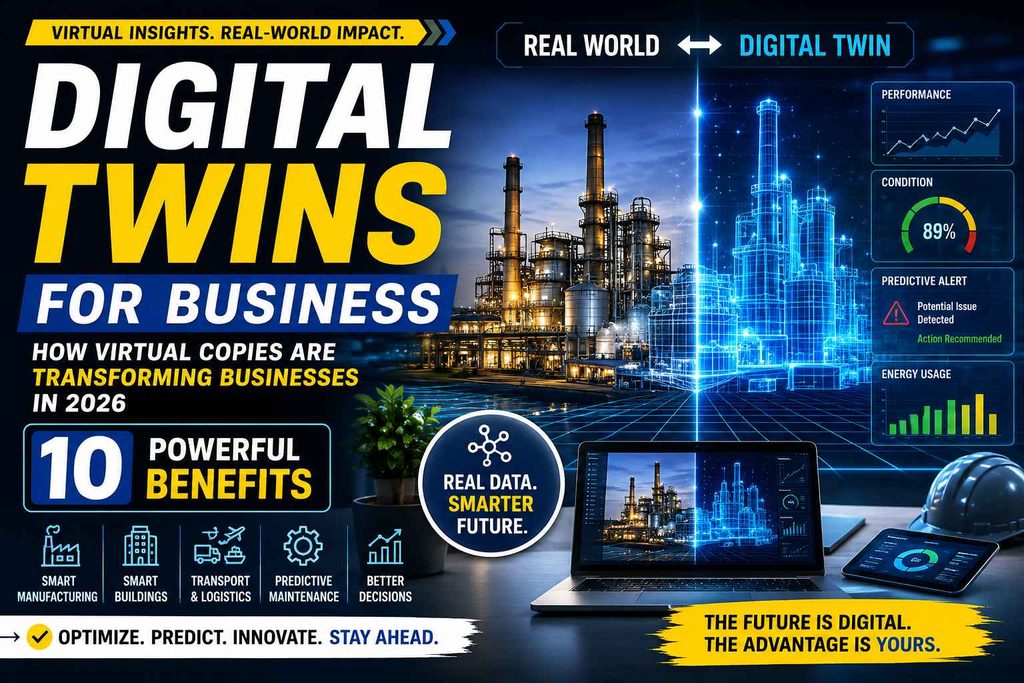
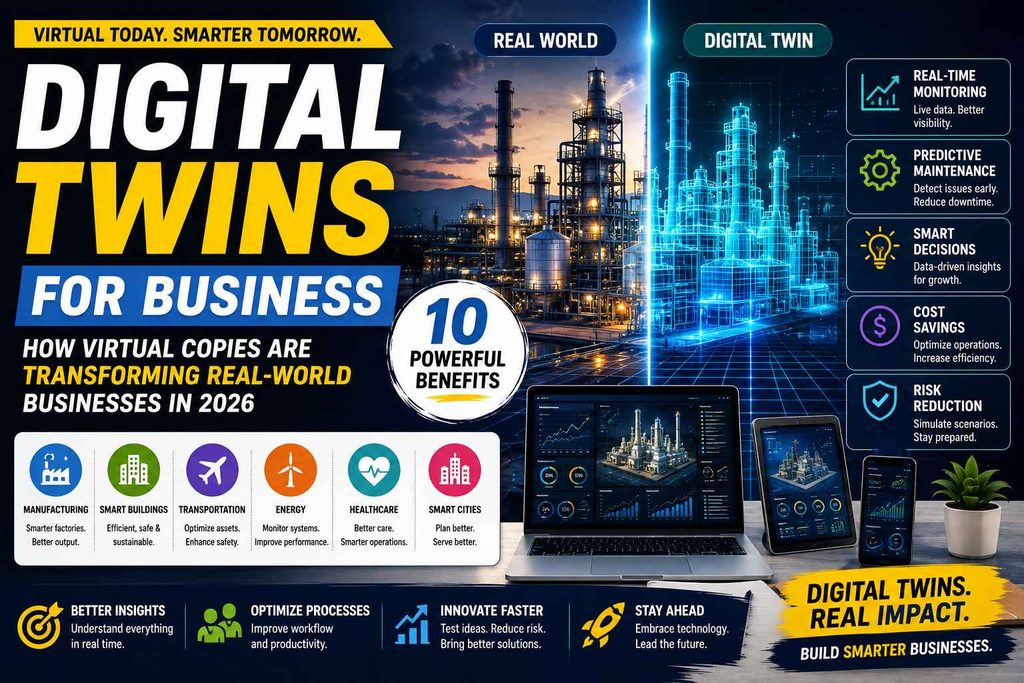
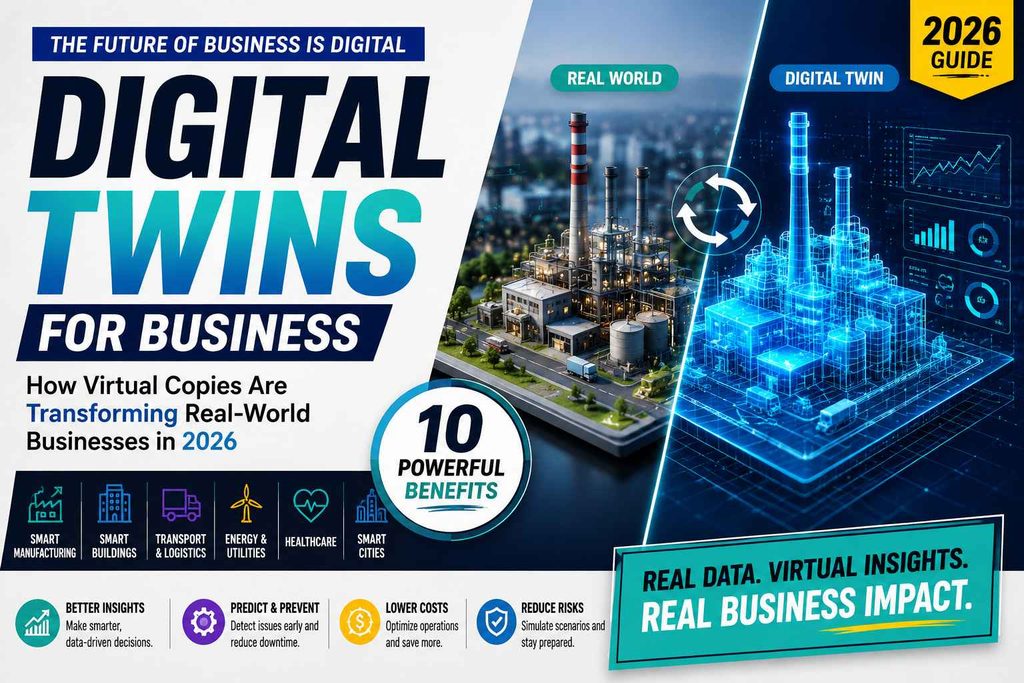
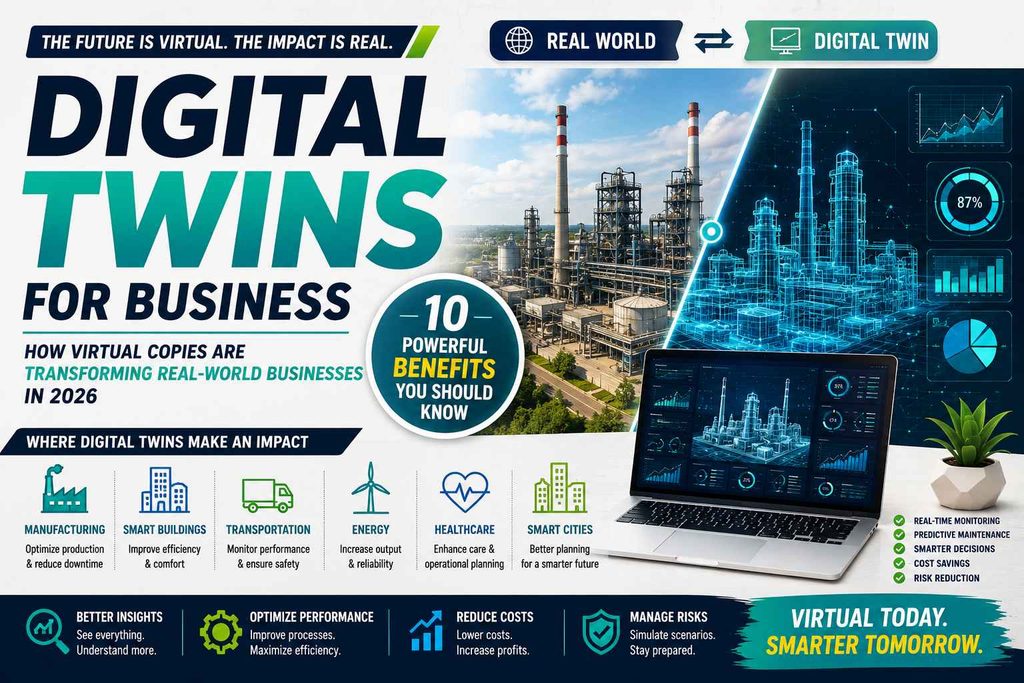
A Digital Twins for Business is a virtual representation of a real-world object, system, process, or environment. Unlike a simple 3D model, a modern digital twin can use real-time data from sensors, connected devices, software systems, and other sources to represent what is happening in the physical world.
Imagine a factory manager being able to see a virtual version of an entire production line on a computer screen. Instead of waiting for a machine to fail, the system could potentially identify unusual behavior and help the team investigate the problem before a major breakdown occurs.
Similarly, an aircraft manufacturer can use digital models and operational data to understand how components perform, while a smart building can use connected systems to monitor energy consumption, temperature, equipment performance, and occupancy.
Digital Twins for Businesss are therefore becoming an important part of the broader digital transformation movement.
In this article, MyFinanceNests explores what digital twins are, how they work, where businesses use them, their major advantages and disadvantages, challenges, real-world applications, future possibilities, and important questions beginners often ask.
What Is a Digital Twins for Business?
A Digital Twins for Business is a virtual representation of a physical object, process, system, or environment that is connected to information about its real-world counterpart.
The physical object could be:
- A machine
- A vehicle
- A building
- A factory
- A power plant
- A wind turbine
- A warehouse
- A city
- A production process
- An entire supply chain
The digital twin can collect and process information from the physical environment and use that information to provide insights into performance and potential problems.
The concept becomes especially powerful when the digital representation is connected to real-time or frequently updated data.
For example, consider an industrial machine.
A traditional digital model might show what the machine looks like.
A Digital Twins for Business could go much further by incorporating information such as:
- Temperature
- Vibration
- Operating speed
- Energy consumption
- Maintenance history
- Production output
- Operating hours
This information can help organizations understand how the real machine is behaving.
Digital Twins for Business vs. Traditional 3D Model
These two concepts are often confused.
A 3D model is primarily a visual or structural representation of an object.
A digital twin can include much more information.
For example:
Traditional 3D Model
A 3D model of a factory might show:
- Walls
- Machines
- Doors
- Floors
- Equipment locations
Digital Twins for Business
A Digital Twins for Business of the same factory might additionally show:
- Machine status
- Energy consumption
- Production activity
- Temperature
- Equipment performance
- Maintenance information
- Sensor data
- Operational alerts
In simple terms:
A 3D model shows what something looks like. A digital twin can help show how something is behaving.
https://myfinancenests.com/financial-news-explained-money-headlines-2026/
How Does a Digital Twin Work?
A digital twin generally depends on several technologies working together.
1. Physical Object
Everything begins with something in the real world.
This could be a machine, vehicle, building, factory, or another physical system.
2. Sensors and Connected Devices
Sensors can collect information from the physical environment.
Depending on the application, sensors may measure:
- Temperature
- Pressure
- Movement
- Vibration
- Humidity
- Speed
- Energy consumption
- Location
3. Data Transmission
The collected information needs to move from the physical environment into a digital system.
This can happen through connected networks, industrial communication systems, wireless technologies, or other data infrastructure.
4. Data Processing
Software platforms process the incoming information.
The system may organize, analyze, visualize, and compare data.
5. Digital Representation
The information is connected to a virtual representation of the physical object or system.
Users can then interact with dashboards, simulations, visualizations, or analytical tools.
6. Analysis and Decision-Making
The final goal is usually not simply creating a virtual copy.
The real value comes from using information to support decisions.
Organizations can potentially use digital twins to:
- Detect unusual behavior
- Optimize processes
- Test scenarios
- Improve maintenance
- Reduce waste
- Understand performance
- Plan changes
Why Are Digital Twins Becoming Important?
Modern businesses generate enormous amounts of data.
Machines produce operational data.
Buildings generate energy data.
Vehicles generate location and performance data.
Factories generate production data.
However, collecting data is not enough.
Businesses need ways to understand that information and connect it to real-world operations.
Digital twins can provide a visual and analytical framework for connecting physical systems with digital information.
Instead of looking at thousands of disconnected data points, decision-makers can potentially view information in the context of the physical system.
This can make complex environments easier to understand.
Major Applications of Digital Twins
Digital Twins for Business are not limited to one industry.
Their potential applications extend across many sectors.
Manufacturing
Manufacturing is one of the most important areas for digital twin technology.
Factories contain complex equipment, production lines, robots, sensors, and processes.
A Digital Twins for Business can help manufacturers visualize production operations and analyze machine performance.
Potential uses include:
- Predictive maintenance
- Production optimization
- Equipment monitoring
- Factory planning
- Quality improvement
- Energy management
Before making a physical change to a production process, businesses can also use simulations to explore possible outcomes.
This can reduce the need for expensive physical experimentation.
Digital Twins in Healthcare
Healthcare is another area where digital modeling can have significant potential.
Digital Twins for Business concepts can be applied to medical equipment, hospital operations, and potentially personalized healthcare research.
For example, a digital representation of hospital operations could help organizations analyze:
- Patient flow
- Equipment utilization
- Room availability
- Staff workloads
- Resource requirements
More advanced applications may involve creating models that support research into how particular treatments or procedures could affect patients.
However, healthcare applications require extremely high standards for privacy, safety, validation, and regulatory compliance.
Digital Twins in Smart Buildings
Buildings are becoming increasingly connected.
Modern buildings may contain systems for:
- Heating
- Cooling
- Lighting
- Security
- Elevators
- Energy management
- Access control
A Digital Twins for Business can bring information from these systems together.
Building managers could potentially use the digital environment to understand energy consumption and equipment performance.
For example, if an HVAC system is consuming unusually high amounts of energy, the digital twin could help identify where the problem might be occurring.
Digital Twins in Transportation
Vehicles and transportation infrastructure can generate enormous amounts of operational data.
Digital Twins for Business can potentially be used for:
- Aircraft
- Trains
- Ships
- Cars
- Roads
- Airports
- Railway systems
An organization could create a digital representation of a vehicle and connect it with information about operating conditions.
This could support maintenance planning and performance analysis.
Transportation infrastructure can also benefit.
For example, a digital model of a railway network could help planners study capacity, congestion, maintenance requirements, and possible changes.
Digital Twins in Energy
Energy infrastructure is complex and expensive.
Power plants, wind turbines, solar installations, transmission systems, and other assets require careful monitoring.
Digital Twins for Business can potentially help operators understand:
- Equipment performance
- Energy production
- Maintenance requirements
- Environmental conditions
- Operational efficiency
For renewable energy systems, digital models can also help organizations understand how changing environmental conditions affect performance.
Digital Twins and Smart Cities
One of the most ambitious applications is the creation of digital representations of cities.
A smart-city digital twin could potentially represent:
- Roads
- Buildings
- Public transportation
- Traffic
- Energy systems
- Water infrastructure
- Public spaces
- Environmental conditions
City planners could potentially use such systems to explore different scenarios before implementing physical changes.
For example, they could model how a new road might affect traffic or how a new building could influence energy consumption and urban activity.
Pros of Digital Twins
Digital Twins for Business can provide several important advantages.
1. Better Decision-Making
One of the biggest benefits is improved visibility.
Instead of relying entirely on assumptions, decision-makers can use operational data and simulations to understand systems.
Better information can support better decisions.
2. Predictive Maintenance
Traditional maintenance often follows fixed schedules.
For example, a machine might receive maintenance every six months regardless of its actual condition.
Digital Twins for Business technology can potentially support condition-based or predictive maintenance by analyzing operational information.
If a machine begins showing unusual vibration or temperature patterns, the organization may investigate before a major failure occurs.
3. Reduced Downtime
Unexpected equipment failures can be expensive.
Production may stop, workers may be affected, and customers may experience delays.
Identifying potential problems earlier can help organizations reduce certain types of downtime.
4. Improved Efficiency
Digital Twins for Business can help organizations identify inefficient processes.
For example, a factory might discover that a particular machine consumes excessive energy or that a production process creates unnecessary delays.
5. Safer Testing
Testing changes in the physical world can be expensive and sometimes dangerous.
Simulation can allow organizations to explore scenarios digitally before implementing changes.
6. Better Product Development
Companies can use digital representations during product development.
Engineers may simulate different designs and operating conditions before building multiple physical prototypes.
This can potentially reduce development time and costs.
https://www.nist.gov/?utm_source=chatgpt.com
Cons of Digital Twins
Despite their potential, digital twins also have significant disadvantages.
1. High Implementation Costs
Creating a sophisticated digital twin can require:
- Sensors
- Software
- Cloud infrastructure
- Data platforms
- Skilled employees
- Cybersecurity systems
- Integration with existing technology
For small businesses, these costs may be difficult to justify.
2. Data Quality Problems
A Digital Twins for Business is only as useful as the information supporting it.
If sensors produce inaccurate, incomplete, delayed, or inconsistent data, the digital representation may not accurately reflect reality.
Poor data can lead to poor decisions.
3. Cybersecurity Risks
Connected systems create cybersecurity challenges.
A Digital Twins for Business may be connected to operational technology, databases, cloud platforms, and IoT devices.
Protecting these systems against unauthorized access is extremely important.
4. Technical Complexity
Digital Twins for Business can involve multiple technologies.
Organizations may need expertise in:
- IoT
- Cloud computing
- Data analytics
- Artificial intelligence
- Software development
- Cybersecurity
- Engineering
Finding people with the right combination of skills can be difficult.
5. Integration Challenges
Many organizations already use older software and equipment.
Connecting new digital twin platforms with existing systems can be complicated.
Some machines may not have modern connectivity capabilities.
Digital Twins and Artificial Intelligence
Artificial intelligence can make digital twins more powerful.
A basic digital twin may show current information.
AI can potentially analyze that information and identify patterns.
For example, an AI-powered system could analyze years of machine data and identify patterns associated with equipment failures.
AI can also potentially support:
- Predictive maintenance
- Anomaly detection
- Demand forecasting
- Process optimization
- Automated recommendations
- Scenario analysis
The combination of digital twins + AI + IoT could become an important technology stack for future industrial systems.
However, AI-generated predictions should not automatically be treated as perfect.
Organizations still need human oversight, data validation, and appropriate testing.
Digital Twins and the Internet of Things
The Internet of Things (IoT) refers to connected physical devices that can collect and exchange information.
IoT devices are often an important data source for digital twins.
Consider a smart factory.
IoT sensors collect information from machines.
Digital twin for Businesses should also understand how economic developments can influence technology investments. Read our guide to financial news to learn how economic headlines can affect businesses and consumer
The information is transmitted to a digital platform.
The Digital Twins for Business uses that information to represent the condition of the physical factory.
This creates a connection between:
Physical World → Sensors → Data → Digital Twin → Analysis → Decision
This connection is one of the key ideas behind modern digital transformation.
Companies adopting new technologies should also understand broader market conditions. Our guide to stock market for beginners explains important concepts about markets and investin
Digital Twins and Cloud Computing
Large digital twin systems can generate enormous quantities of data.
Cloud computing can provide infrastructure for storing, processing, and analyzing that information.
Cloud platforms can potentially make digital twin systems more scalable.
Instead of maintaining all computing infrastructure locally, organizations can use cloud resources depending on their requirements.
However, cloud adoption also creates considerations around:
- Data privacy
- Security
- Availability
- Costs
- Compliance
- Vendor dependence
How Small Businesses Can Use Digital Twins
Digital twins may sound like technology designed only for huge corporations.
That is not necessarily the case.
Small businesses may be able to use simpler versions of the concept.
For example, a small manufacturing company could create a digital representation of a production machine and monitor:
- Operating hours
- Temperature
- Energy use
- Maintenance schedules
- Production output
A property-management business could monitor building systems.
A logistics company could track vehicle performance.
The key is to start with a specific business problem rather than trying to digitize everything at once.
stock market for beginners
How to Start a Digital Twin Project
Organizations considering digital twin technology should avoid starting with technology alone.
A better approach is to begin with a business problem.
Step 1: Identify a Problem
Ask:
What problem are we trying to solve?
Examples include:
- Too much equipment downtime
- High energy consumption
- Production delays
- Difficult maintenance planning
Step 2: Select the Asset
Choose one machine, building, process, or system.
Step 3: Identify Required Data
Determine what information is necessary.
Do not collect data simply because it is available.
Step 4: Connect Sensors and Systems
Use appropriate technologies to collect reliable information.
Step 5: Build the Digital Representation
Create the digital environment and connect it to real-world information.
Step 6: Analyze Results
Measure whether the system is actually improving the original problem.
Step 7: Expand Gradually
If the pilot project produces meaningful value, expand the system to other assets or processes.
https://myfinancenests.com/investing-for-beginners-guide-building-wealth-2026/
Common Mistakes Businesses Should Avoid
Trying to Digitize Everything
Digital Twins for Business A company does not need to build a digital twin of its entire operation immediately.
Start small.
Ignoring Data Quality
Digital Twins for Business More data does not automatically mean better information.
Quality matters.
Forgetting Cybersecurity
Connected systems need strong security from the beginning.
Focusing Only on Technology
A Digital Twins for Business should solve a business problem.
Technology without a clear purpose can become an expensive project.
Expecting Instant Results
Complex Digital Twins for Business transformation projects may take time.
Organizations need realistic expectations.
The Future of Digital Twins
The future of Digital Twins for Business could become increasingly connected and intelligent.
As sensors become more affordable, cloud computing becomes more accessible, and AI systems improve, Digital Twins for Business may become easier to deploy.
Future systems could potentially combine:
- Real-time sensor data
- AI
- Machine learning
- Computer vision
- Robotics
- Augmented reality
- Virtual reality
- Cloud computing
- Edge computing
- Advanced analytics
This could create Digital Twins for Business environments where businesses can monitor physical operations and test possible changes before implementing them.
In the future, Digital Twins for Business may also become more accessible to smaller organizations.
Instead of creating enormous custom systems from scratch, businesses may be able to use modular platforms designed for specific industries.
Frequently Asked Questions
What is a digital twin in simple words?
A Digital Twins for Business is a virtual representation of a real-world object, system, process, or environment that can be connected to real-world data.
Is a digital twin the same as a simulation?
Not exactly.
A simulation can model a process or scenario.
A Digital Twins for Business can represent a specific real-world asset and may continuously use information from that asset.
The two technologies can overlap and work together.
Does a digital twin require AI?
No.
A digital twin can exist without artificial intelligence.
However, AI can enhance digital twins by helping analyze data, detect patterns, and generate predictions.
What industries use digital twins?
Potential applications exist in:
- Manufacturing
- Healthcare
- Energy
- Transportation
- Construction
- Real estate
- Aerospace
- Automotive
- Logistics
- Smart cities
Are digital twins expensive?
They can be.
Costs depend on the complexity of the system, number of sensors, software requirements, data infrastructure, and level of integration.
A small pilot project can be much less expensive than creating a digital twin of an entire industrial operation.
Can small businesses use digital twins?
Yes.
Small businesses can start with focused applications such as equipment monitoring, building management, or logistics.
Are digital twins secure?
They can be designed with strong security, but connected systems create cybersecurity risks.
Organizations should implement appropriate authentication, access control, monitoring, encryption, updates, and security policies.
Can a digital twin predict machine failure?
It can potentially help predict failures by analyzing sensor data and identifying unusual patterns.
However, predictions are not guaranteed to be correct.
What is the relationship between IoT and digital twins?
IoT devices can provide real-world data to a digital twin.
The digital twin then uses that information to represent and analyze the physical system.
What is the biggest benefit of digital twins?
One of the biggest potential benefits is the ability to connect real-world operations with digital information, allowing organizations to better understand, monitor, test, and optimize complex systems.
Final Thoughts
Digital Twins for Business represent an important shift in how organizations interact with physical systems.
Instead of looking at the physical world and digital systems as completely separate environments, digital twin technology creates a connection between them.
A machine can have a digital representation.
A building can have a digital representation.
A factory can have a digital representation.
Even an entire city can potentially be represented digitally.
The real value, however, does not come from creating an impressive virtual model alone.
The value comes from data, analysis, simulation, and better decision-making.
Digital Twins for Business can help organizations improve maintenance, understand operations, test scenarios, reduce certain inefficiencies, and develop products more effectively.
At the same time, businesses must recognize the challenges.
Implementation can be expensive. Data quality can be problematic. Integration can be complicated. Cybersecurity becomes increasingly important as more physical systems become connected.
The smartest organizations will therefore avoid adopting digital twins simply because the technology is popular.
Instead, they will ask:
What problem can this technology solve?
That question should come before choosing sensors, software, cloud platforms, or AI tools.
As technology continues to evolve, the combination of IoT, cloud computing, AI, automation, and digital twins could become an important foundation for the next generation of connected businesses.
For companies willing to invest in the right infrastructure and skills, digital twins may offer a powerful way to understand the physical world through digital intelligence.
And for everyone else, the technology provides an important glimpse into where digital transformation may be heading.
The future may not simply be about creating digital versions of physical things. It may be about using those digital versions to make the physical world smarter, more efficient, and easier to understand.
At MyFinanceNests, we believe understanding emerging technologies is an important part of understanding the future of business and the digital economy.
Learn the technology. Understand the opportunities. Know the risks. Build for the future.
Table of Contents