Introduction
Welcome to MyFinanceNests, where smart money decisions start with better planning. In today’s fast-changing financial world, managing irregular expenses can be just as important as saving and investing. Sinking funds offer a simple way to prepare for future costs by setting aside small amounts of money over time. In this guide, we’ll explore how sinking funds work, how to create them, their pros and cons, and how this simple strategy can help you build greater financial confidence in 2026.
Managing personal finances is not only about earning more money. It is also about knowing where your money needs to go before you actually need to spend it. Many people create a monthly budget, pay their regular bills, save a little money, and invest whatever remains. However, there is one major problem with this approach: irregular expenses.
Car repairs, annual insurance payments, holiday shopping, school expenses, property taxes, birthdays, subscriptions, home maintenance, and other occasional costs can suddenly put pressure on your finances. Even when these expenses are not true emergencies, they can still feel like financial emergencies when you have not prepared for them.
This is where a sinking fund can make a major difference.
A sinking fund is a dedicated amount of money that you gradually save for a specific future expense. Instead of waiting until the bill arrives and trying to find the money immediately, you contribute a small amount every month.
For example, imagine you know that your car insurance will cost $1,200 next year. Instead of trying to find $1,200 when the payment is due, you could save $100 per month for 12 months. When the bill arrives, the money is already available.
The concept is simple, but it can completely change the way you handle irregular expenses.
In this guide, we will explain what sinking funds are, how they work, how to create them, their major benefits and disadvantages, common mistakes to avoid, and how you can use sinking funds as part of a smarter financial system in 2026.https://myfinancenests.com/?utm_source=chatgpt.com

What Is a Sinking Fund?
A sinking fund is a savings category created for a specific financial goal or future expense.
Unlike general savings, the money in a sinking fund already has a purpose.
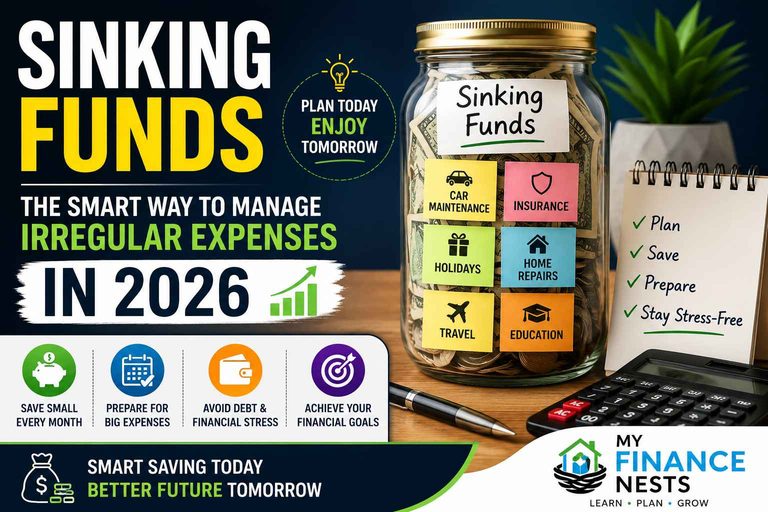
For example, you might have separate sinking funds for:
- Car maintenance
- Insurance
- Holidays
- Christmas gifts
- Home repairs
- Medical expenses
- School costs
- Annual subscriptions
- Property taxes
- Technology upgrades
- Birthdays
- Travel
- Professional expenses
The goal is not necessarily to accumulate a huge amount of money. Instead, the goal is to make large or irregular expenses easier to manage.
Think of it as breaking a large future expense into smaller monthly payments to yourself.
If you need $600 for an expense six months from now, saving $100 per month is much easier than suddenly finding $600 in the sixth month.
Sinking Fund vs Emergency Fund
One of the biggest misunderstandings in personal finance is treating every type of savings as an emergency fund.
A sinking fund and an emergency fund serve different purposes.
Emergency Fund
An emergency fund is designed for unexpected financial problems such as:
- Sudden job loss
- Major unexpected medical expenses
- Urgent home repairs
- Unexpected transportation problems
- Other serious financial emergencies
Sinking Fund
A sinking fund is designed for expenses that you can reasonably anticipate.
For example:
“I know my car insurance is due next year.”
That is not an emergency.
Or:
“I know I want to buy holiday gifts in December.”
That is also not an emergency.
These expenses can be planned for with sinking funds.
This distinction is important because using your emergency savings for predictable expenses can gradually weaken your financial safety net.
Your emergency fund protects you from the unexpected, while sinking funds help you prepare for the expected.https://consumer.gov/your-money/budget-worksheet?utm_source=chatgpt.com
Why Sinking Funds Matter in 2026
Modern household expenses can be difficult to manage because not every expense arrives monthly.
Some bills appear quarterly, annually, or only a few times a year.
Imagine someone has the following annual expenses:
| Expense | Estimated Cost |
|---|---|
| Car insurance | $1,200 |
| Vehicle maintenance | $600 |
| Holiday gifts | $800 |
| Home maintenance | $1,000 |
| Annual subscriptions | $400 |
| Travel | $1,200 |
| Total | $5,200 |
At first, $5,200 can look overwhelming.
But if these expenses are spread across 12 months:
$5,200 ÷ 12 = about $433 per month
Instead of dealing with several financial shocks throughout the year, the person could plan to put approximately $433 per month toward these future expenses.
The exact amount will depend on your personal situation, income, priorities, and estimates, but the principle remains the same.
Planning turns large irregular expenses into smaller predictable savings contributions.

How to Create a Sinking Fund
Creating a sinking fund does not require a complicated financial system.
You can start with five simple steps.
Step 1: Identify Your Irregular Expenses
Start by looking at your previous 12 months of spending.
Review your bank statements, credit card statements, receipts, and bills.
Look for expenses that:
- Do not happen every month
- Are relatively large
- Are predictable
- Could create financial stress if ignored
Write them down.
For example:
- Car registration
- Insurance
- Holiday spending
- Home repairs
- Annual memberships
- School expenses
- Travel
Do not worry about making the system perfect at first.
The goal is to identify the expenses that repeatedly surprise you.
Step 2: Estimate the Annual Cost
Once you identify an expense, estimate how much you will need.
Suppose you expect to spend:
$1,000 per year on car maintenance.
You can divide the annual target by the number of months available.
$1,000 ÷ 12 = $83.33
So you could save approximately $84 per month.
If you expect to need the money sooner, divide the amount by the number of months remaining.
For example, if your insurance bill is $900 and you have six months to prepare:
$900 ÷ 6 = $150 per month
This gives you a clear monthly target.
Step 3: Give Every Fund a Clear Name
One useful feature of sinking funds is that each fund has a specific purpose.
Instead of having one large savings account labeled simply “Savings,” you can organize your goals into categories.
For example:
Car Fund
For maintenance, registration, tires, and repairs.
Travel Fund
For flights, hotels, food, and other travel expenses.
Holiday Fund
For gifts, decorations, events, and seasonal expenses.
Home Fund
For maintenance, appliances, furniture, and repairs.
Annual Bills Fund
For yearly subscriptions, insurance, memberships, and similar expenses.
Clear categories make it easier to understand why you are saving.
Step 4: Automate Your Contributions
One of the easiest ways to maintain a sinking fund is automation.
Instead of relying on motivation every month, schedule your contribution around payday.
For example:
- $100 → Car Fund
- $75 → Travel Fund
- $50 → Holiday Fund
- $50 → Home Fund
The exact amounts depend on your financial situation.
Automation helps because the money is moved before you have an opportunity to spend it elsewhere.
However, automation should still fit comfortably within your overall budget.
Step 5: Review Your Funds Regularly
Your expenses will change over time.
A sinking fund that made sense last year may need to be adjusted this year.
Review your funds every few months.
Ask:
- Is my target still realistic?
- Has the price of this expense changed?
- Do I still need this fund?
- Am I saving too much?
- Am I saving too little?
- Do I have another financial priority?
A short review can prevent your system from becoming outdated.

Examples of Useful Sinking Funds
There is no universal list of sinking funds because everyone’s financial life is different.
However, several categories are commonly useful.
Car Sinking Fund
Cars can create expenses that do not occur every month.
You might need money for:
- Oil changes
- Tires
- Registration
- Repairs
- Maintenance
- Insurance deductibles
Saving a small amount regularly can make these expenses easier to absorb.
Holiday Sinking Fund
Holiday spending can become expensive when gifts, travel, food, and entertainment are all purchased within a short period.
Instead of waiting until the holiday season, estimate your total expected spending and divide it across the months before the event.
This allows you to enjoy the occasion without relying heavily on credit.
Home Maintenance Fund
Homeowners often encounter expenses such as:
- Plumbing repairs
- Appliance replacement
- Painting
- Roof maintenance
- Heating and cooling repairs
- Furniture replacement
Not every expense can be predicted exactly, but setting aside money for general maintenance can provide useful flexibility.
Travel Fund
Travel is another excellent example.
If you want to spend $2,400 on a trip next year, you could divide the target across the months before the trip.
Instead of financing the entire trip with debt or draining your general savings, you gradually build the money in advance.
Pros of Sinking Funds
Sinking funds offer several important benefits.
1. They Reduce Financial Stress
Large expenses can be stressful when you are not prepared.
Knowing that money has already been set aside can make the expense much easier to handle.
2. They Help Prevent Credit Card Debt
Without savings, people may use credit cards or loans to cover predictable expenses.
A sinking fund can reduce the need to borrow for expenses that you knew were coming.
3. They Make Budgeting More Realistic
A normal monthly budget can sometimes make expenses look smaller than they actually are.
For example, an annual $1,200 expense is equivalent to $100 per month.
A sinking fund allows you to recognize that cost throughout the year rather than pretending it does not exist until the bill arrives.
4. They Protect Your Emergency Fund
Because sinking funds are designed for predictable expenses, you are less likely to use emergency savings for things you could have planned for.
That helps preserve your emergency fund for genuine emergencies.
5. They Encourage Financial Discipline
Regular contributions develop a habit of saving for future needs.
Over time, this can improve your overall money management skills.
Cons of Sinking Funds
Sinking funds are useful, but they are not perfect.
1. They Require Planning
You need to identify your future expenses and estimate their costs.
If you do not review your spending, you may overlook important categories.
2. Too Many Funds Can Become Complicated
Creating 20 different savings categories can become difficult to manage.
For some people, a smaller number of broader categories may work better.
The goal is to make your finances simpler—not more complicated.
3. Your Estimates May Be Wrong
An expense might cost more than expected.
For example, you may estimate $600 for car maintenance but eventually need $900.
Therefore, estimates should have some flexibility.
4. Sinking Funds Are Not an Investment Strategy
Money needed for near-term expenses generally should not be treated like long-term investment money.
The purpose of a sinking fund is stability and availability, not maximum investment growth.
Common Sinking Fund Mistakes
Mistake 1: Saving Too Little
If your expected expense is $1,200 but you save only $500, you will still face a shortfall.
Try to make your estimates realistic.
Mistake 2: Using One Fund for Everything
If all savings are mixed together, it becomes difficult to know how much is actually available for each goal.
Clear categories can help.
Mistake 3: Forgetting Annual Expenses
Look at your previous year’s spending to identify bills that do not appear every month.
Mistake 4: Treating Sinking Funds Like Emergency Savings
Remember that the purpose is different.
Mistake 5: Creating an Overly Complicated System
A simple system you consistently use is better than a sophisticated system you abandon after two months.
Sinking Funds for People With Irregular Income
Sinking funds can be especially helpful when income changes from month to month.
Freelancers, contractors, business owners, commission-based workers, and people with seasonal income may not receive the same amount every month.
Instead of automatically contributing the exact same amount, they can use a percentage-based approach.
For example, whenever income arrives, a person might allocate a portion toward future expenses.
The exact percentage should depend on their income stability and essential expenses.
During higher-income months, they may be able to contribute more. During lower-income months, contributions can be reduced if necessary.
The important thing is to maintain awareness of upcoming expenses rather than ignoring them.

How Sinking Funds Fit Into a Bigger Financial Plan
A sinking fund should not exist by itself.
It can be one part of a broader money-management system.
A practical financial structure might include:
Income → Essential Expenses → Emergency Savings → Sinking Funds → Debt Goals → Long-Term Investing
The exact order can change depending on your personal circumstances.
For example, someone with high-interest debt may prioritize debt repayment differently from someone who has no debt.
Someone without an emergency reserve may need to build financial security before aggressively increasing long-term investments.
The important point is that each type of money should have a clear purpose.
A Simple Sinking Fund Example
Imagine someone earns $4,000 per month after taxes.
They identify these annual expenses:
- Car maintenance: $600
- Insurance: $1,200
- Holiday spending: $600
- Travel: $1,200
- Home maintenance: $600
Total:
$4,200 per year
Dividing $4,200 by 12 months gives:
$350 per month
That person could aim to allocate approximately $350 each month toward these future expenses.
Instead of being surprised by $600, $1,200, or $1,200 expenses throughout the year, they are gradually preparing for them.
This is the core power of a sinking fund.
Sinking Funds vs Saving Everything in One Account
There is no single correct way to organize savings.
Some people prefer separate accounts or categories for every goal.
Others prefer one savings account with a spreadsheet or budgeting app that tracks different targets.
Both approaches can work.
The most important factors are:
- Clear goals
- Accurate estimates
- Regular contributions
- Easy tracking
- Consistent reviews
Choose the system that you are most likely to maintain.
Final Thoughts
A strong financial plan is not only about making more money. It is also about preparing for the expenses you already know are coming.
Sinking funds provide a simple way to turn irregular expenses into predictable monthly savings goals.
Instead of waiting for an annual bill, holiday expense, car repair, or planned trip to disrupt your budget, you can prepare gradually.
The biggest advantage is not simply having money available. It is gaining greater control over your financial decisions.
Start small.
Choose two or three expenses that repeatedly cause financial stress. Estimate their yearly cost, divide the amount by the number of months available, and begin making regular contributions.
As your system becomes easier to manage, you can add more categories.
Remember that a sinking fund is different from an emergency fund, and neither replaces a long-term investment strategy. Each serves a different purpose.
The goal is to build a financial system where your money has a job before you need it.
Plan ahead, save consistently, and make future expenses easier to handle.
That is the real value of sinking funds.
Table of Contents